
for the second week of contextualising, i made a long receipt that mimicks a bureaucratic tone but actually exposes what gets hidden in between silos of data.

our group decided to use this as a format to present our final work. at first, i had intended for this receipt to be a printed publication, complete with images and illustrations, however in combining my ideas with my group, we decided that the container for our project should be a website.
my introduction to …
. ݁₊ ⊹ . ݁˖ . ݁vibecoding. ݁₊ ⊹ . ݁˖ . ݁
I’d seen the term “vibecoding” floating around and it felt like something that applied to people who already kind of knew what they were doing. i, however, had the most baseline coding knowledge ever. There is something vulnerable about not understanding the thing you’re making. With Illustrator or figma, even when I’m trying something new, I have enough foundational knowledge that I can diagnose what’s going wrong. With code, I had practically nothing. When something broke, I didn’t know if it was a small thing or a fundamental thing. i felt like every edit i made might have detonated something.
i started with wanting to keep the idea of materials remaining on earth for many years into the future, so i tried creating a “temporal lens,” where if you clicked a button, the receipt would blur out everything except dates and timelines as you scroll down.
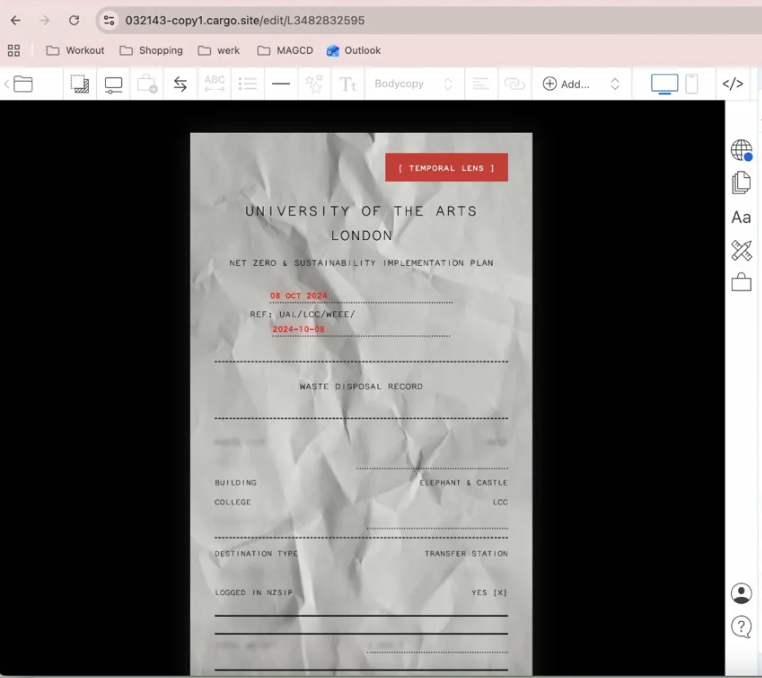
however, there were too few dates and timelines throughout the whole receipt, so i pivoted to the idea of the entire receipt morphing into a map (very ambitious for someone who knows 0 code, unfortunately :’) ) and as you scroll down the receipt, your cursor functions as a ship, and you are following the trail of e-waste that originated at UAL, to its transfer station at sittingbourne, to shenzhen, and then to the global south, where it accumulates in a pile at the bottom of the map.
my code for this, however, failed…
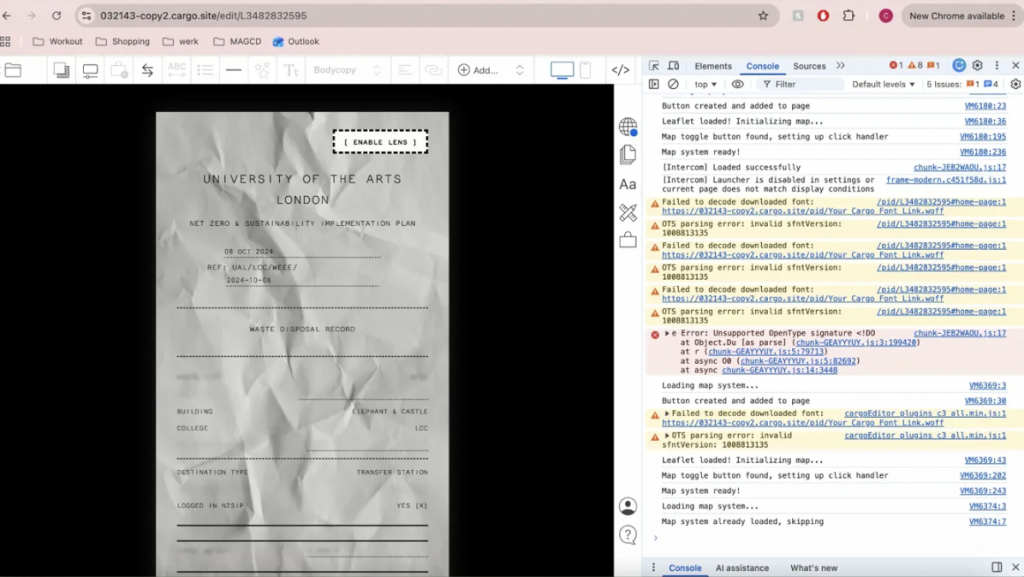

i therefore pivoted yet again, to the idea of waste following the user of the site no matter where they navigated, in order for there be no escape from accountability, the same way the waste itself has no safe destination.
(very) Slowly, I started to build up enough context that the process of vibecoding felt less like hitting enter and praying and hoping for the best, and more like a back-and-forth of what i wanted to input or fix.
with the help of my groupmates, we eventually refined the code so that the container moved more smoothly into the pile of e-waste accumulating at the bottom of the screen.
It wasn’t lost on me that Claude, the AI I was vibecoding with, runs on data centres full of hardware that will one day become the kind of waste we were documenting. I was using one end of the chain to examine the other end. Whether that is poetic or just hypocritical probably depends on who you ask…
Leave a Reply