
i knew from reading the brief that i wanted my iterations to be illustration-based, so i chose a flower from a study that i did during methods of investigating to be the source of my iterations.
i also knew that if i didn’t set a condition for my iterations, i would be drawing things randomly and arbitrarily, thus i thought a reasonable condition was:
- look at the previous iteration for 5 seconds
- hide previous iteration
- draw from memory within 2 minutes
- no erasing
- repeat x100.
i was quite interested in feedback loops as my methods of iterating project involved a lot of experimentation with machine feedback loops, ie., riso –> computer, but i wondered what would happen if my hand was the feedback loop.
some reflections from this exercise:
- the first 5 iterations were the most distinct.
- by iteration 30, my hand had learnt how to draw this flower with muscle memory and i noticed i wasnt quite looking intently at my previous iteration and trying to remember every detail with my eye anymore
- by iteration 50, i dont think i even had to look at the previous iteration for 5 seconds
- by iteration 80, all my flowers started looking really similar
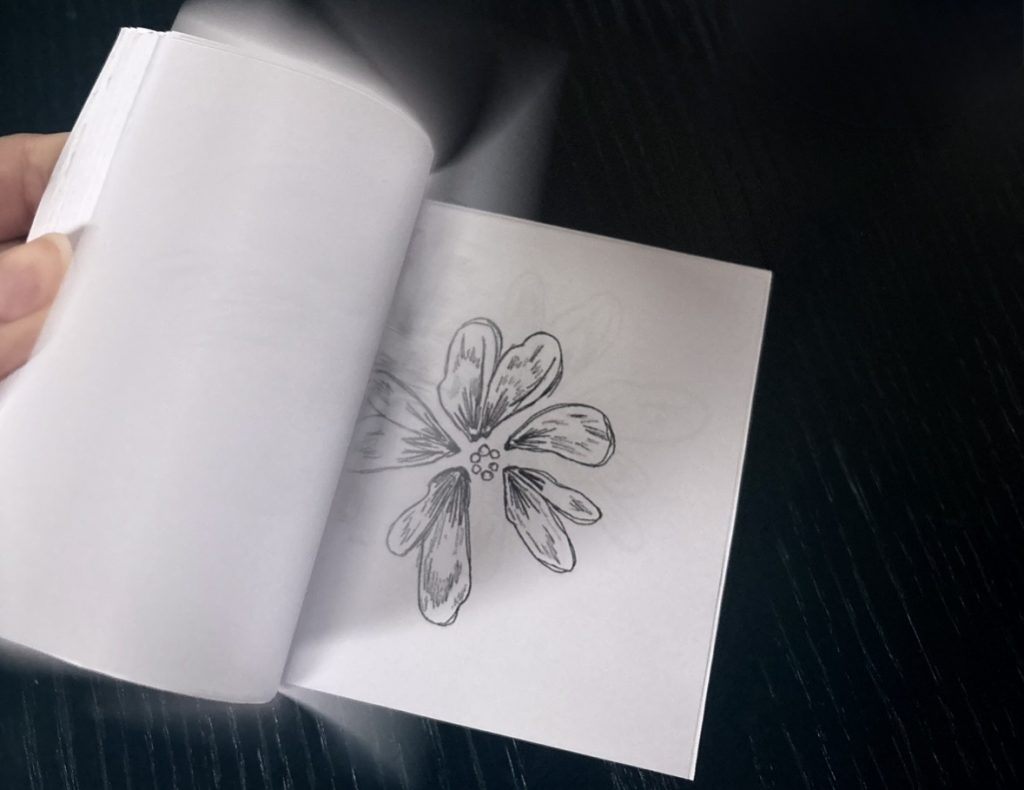
i realised that this exercise became a self-portrait of my memory, not just a human feedback loop, and i really loved seeing the way that my flower evolved when i played my drawings back as an animation. i thus decided to make my publication a flip book as to obtain the same effect.
around that same time, i was going down a rabbit hole on the concept of ‘anemoia‘, which a concept coined in the dictionary of obscure sorrows as the feeling of nostalgia for a time you never actually lived through. it’s a strange sensation because it has no rational basis. you can’t miss something you never had. i kept seeing the same name cited in everything i was reading: svetlana boym. so i read her.
her distinction between restorative and reflective nostalgia is the part that stuck. restorative nostalgia tries to rebuild what was lost — it wants the original back, faithfully reconstructed, as if the loss never happened. reflective nostalgia knows that’s impossible. so instead it dwells in the longing itself. it doesn’t try to fix the gap between past and present. it lives in that gap, and it keeps the damage visible.
Leave a Reply