First Draft ꄗ
This project raised a set of critical questions that emerged directly from the tension between my existing illustration practice and the logic of risograph printing. Coming from a layer-based digital workflow, I am used to flexibility/concealment and reversibility; layers can be hidden, reordered, or overridden, allowing decisions to remain provisional. Working within risograph logic disrupted this entirely. Every shape either prints or it does not, colours cannot hide beneath one another, and absence of ink must be deliberately constructed. This led me to ask what happens when an illustration practice built on flexibility and concealment is forced to operate within a system that demands visibility and commitment?
This experience also prompted questions about time and function. Risograph was historically designed for fast, economical duplication (schools, offices, and administrative contexts,) yet my process was slow, deliberate, and contemplative. This raised further questions: how does a medium built for fast duplication resist slow image-making, and what does it mean to “waste time” using a machine designed to save it? More broadly, how does using risograph for expressive illustration contradict its original utilitarian function, and does contemporary artistic use resist that intent or extend it into new forms of communication? Finally, this led me to question whether the current aestheticisation of risograph represents a misunderstanding of the tool, or a productive reappropriation that reveals new possibilities within its constraints.
Second Draft ꄗ
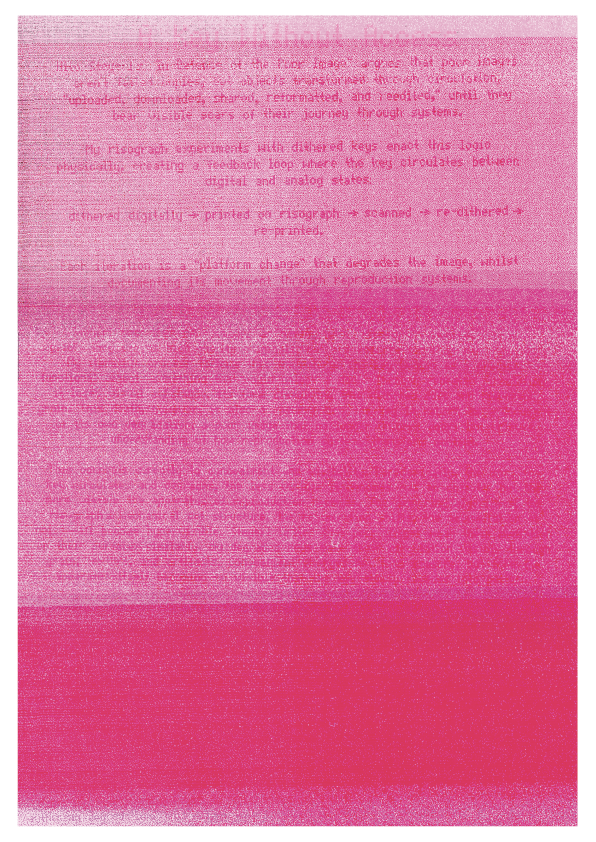
Hito Steyerl’s “In Defence of the Poor Image” argues that poor images aren’t failed copies, but objects transformed through circulation, “uploaded, downloaded, shared, reformatted, and reedited,” until they bear visible scars of their journey through systems.
My risograph experiments with dithered keys enact this logic physically, creating a feedback loop where the key circulates between digital and analog states:
Dithered digitally → printed on risograph → scanned → re-dithered → re-printed.
Each iteration is a “platform change” that degrades the image, whilst documenting its movement through reproduction systems.
Steyerl describes poor images as having been “ripped, reproduced, ripped again”—they die as high-quality originals, but are resurrected with new functions. My iterative process follows this trajectory. The key begins as a precise, functional object—something that could unlock a door. Through repeated circulation, it loses visual substance, its form dissolving into dithered dots and risograph grain. This death, however, is also a resurrection: the key is reborn as a document of its own degradation, a poor image that no longer unlocks doors but unlocks understanding of how reproduction systems transform content.
This connects directly to concealment and visibility. Paradoxically, the more the key circulates and degrades, the less visible it becomes as an object, but the more visible the apparatus of reproduction becomes. The dithering algorithms, the risograph’s mechanical dot structure, the registration shifts, the accumulation of noise—all become hypervisible. Steyerl writes that poor images wear their mediation on their surface; similarly, my degraded keys make their circulation visible through grain, texture, and artifacts. Concealment emerges not from erasure, but from the apparatus itself becoming so visible that the key simply recedes into pattern.
The choice to work with the risograph is significant. As a digital duplicator associated with DIY culture and accessible reproduction, it aligns with Steyerl’s argument that poor images belong to a commons rather than an archive. The machine’s hackability and community-oriented ethos reflect the democratic circulation Steyerl celebrates. By pre-dithering images before feeding them to a machine that already dithers, I create deliberate redundancy—a subversion of the risograph’s function. Instead of disseminating clear information, I am circulating degradation itself. Each print doesn’t serve the original; it serves the process.
The iterative methodology emerged from critique that my earlier halftone experiments were “too controlled, too outcome-based.” Shifting from halftoning (my imposed aesthetic) to dithering (the machine’s native logic) meant submitting to system conditions rather than authoring degradation. This aligns with Conditional Design’s principle that “process is more important than outcome.” The feedback loop is about following a protocol until the key transforms completely, rather than about creating variations.
Ultimately, these experiments test Steyerl’s claim that poor images gain “a new aura” through circulation. The key becomes evidence of its own journey—resurrected as a record of transformation through systems, where concealment and visibility collapse into each other.
Render ꄗ